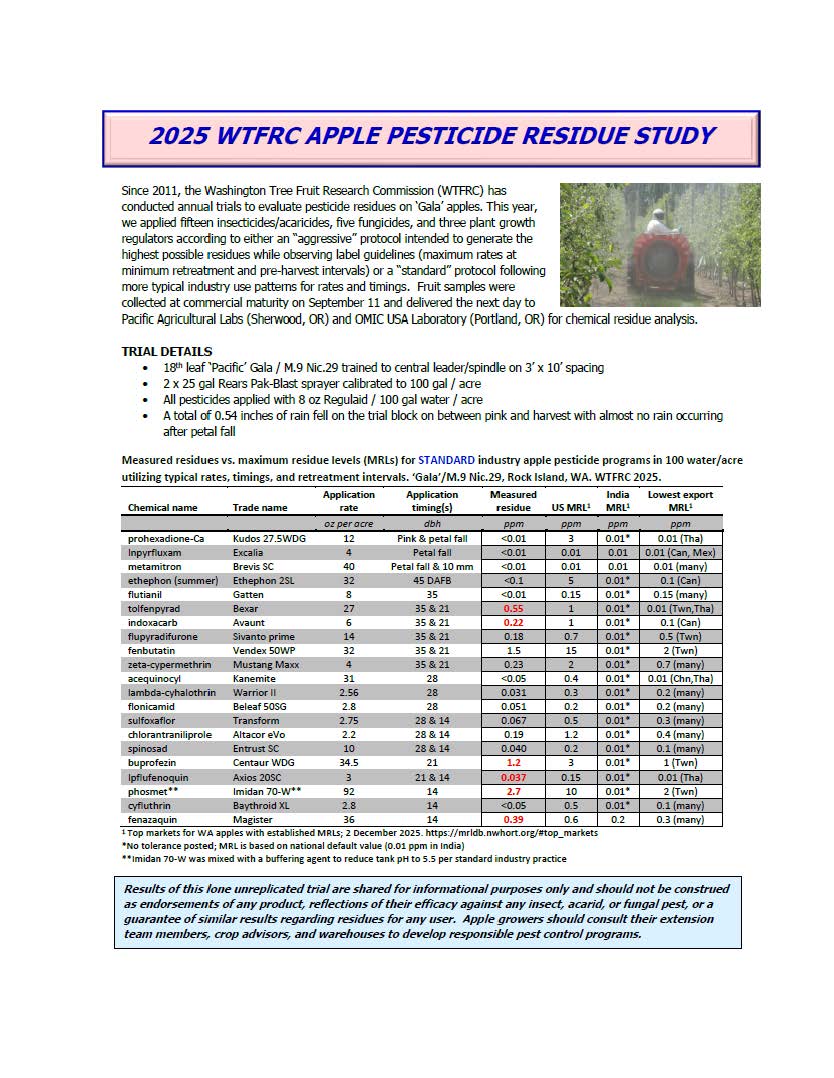
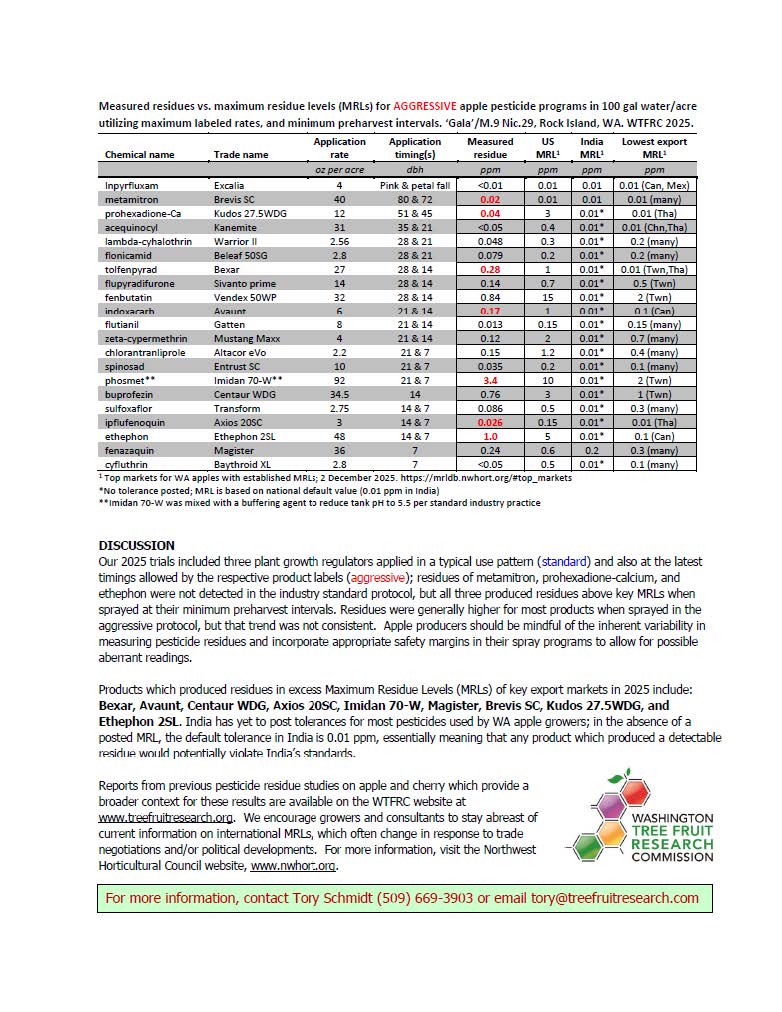
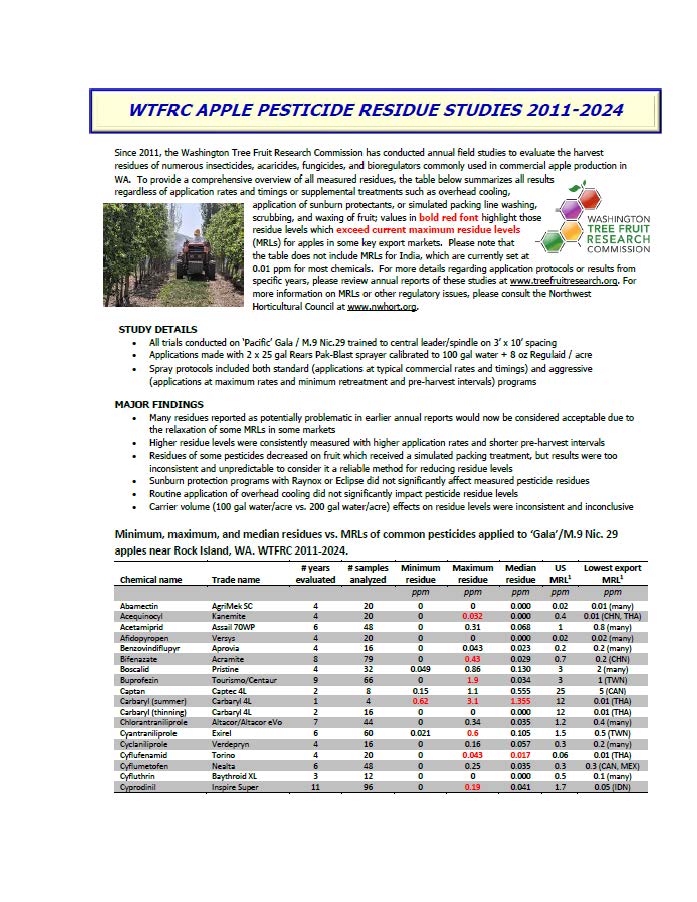
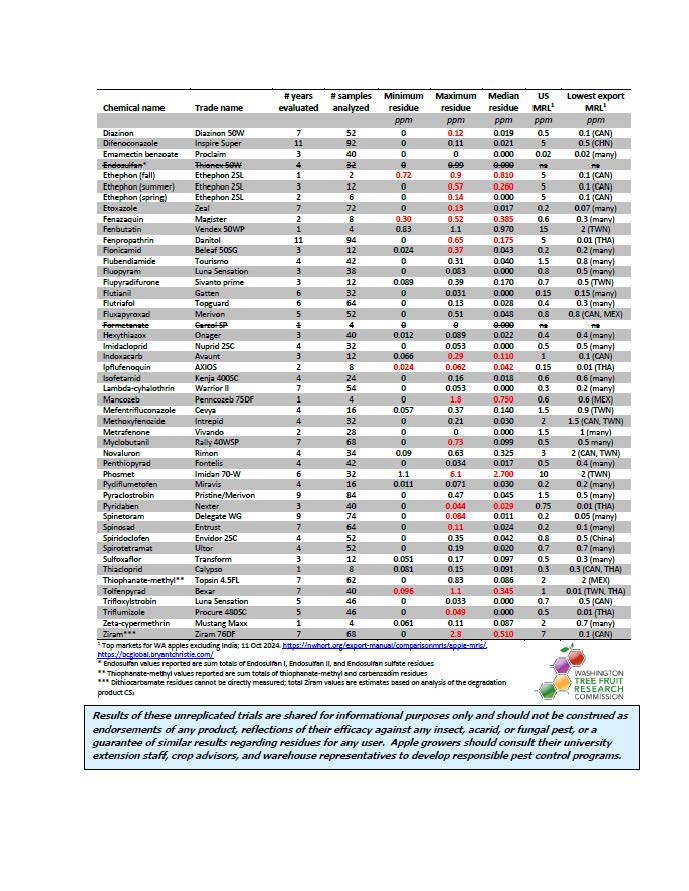
Summary: The Washington Tree Fruit Research Commission (WTFRC) has conducted annual pesticide residue studies in apple and cherry since 2011 to provide basic data to the tree fruit industry regarding residue levels of commonly used pesticides. This information is used by growers, consultants, and fruit sales desks to help guide management decisions regarding spray programs for fruit being exported to foreign markets which may have more stringent Maximum Residue Level (MRL) tolerances than those allowed for fruit sold domestically. For these studies, various fungicides, insecticides, acaricides, and plant growth regulators were sprayed at typical rates and timings used by the WA apple industry, as well as in a “worst case scenario” in which products were applied at maximum rates and minimum preharvest and retreatment intervals in an effort to generate the highest possible residues while still following product label guidelines. Applications were made to a high density ‘Gala’ orchard with an airblast sprayer calibrated to 100 gallons water/acre. Fruit were then sampled at standard harvest timing and submitted to commercial labs for residue analysis. Results have consistently found that residue levels of nearly all pesticides applied were safely below tolerances set for the United States market by the Environmental Protection Agency (EPA), but many residues have exceeded MRLs for some important apple export markets. Most of these potentially problematic cases have been for countries that have either set their MRLs at the minimum limit of detection for those particular products, or have not posted MRLs for those pesticides, such as India; in those cases, imported fruit in those markets cannot have residues which exceed that nation’s default level for MRLs, which is frequently a very stringent limit such as 0.1 or 0.01 ppm. In response to apple industry interest, our 2025 trial protocols included the plant growth regulators ethephon, prohexadione calcium, and the newly registered chemical thinner, metamitron. No residues of these products were detected when applied at typical industry rates and timings, but residues exceeding MRLs for key export markets were found when those products were applied in our “aggressive” protocol.