Precision Nutrient Management for sweet cherry orchards
Author: Bernardita Sallato
Published: 2027
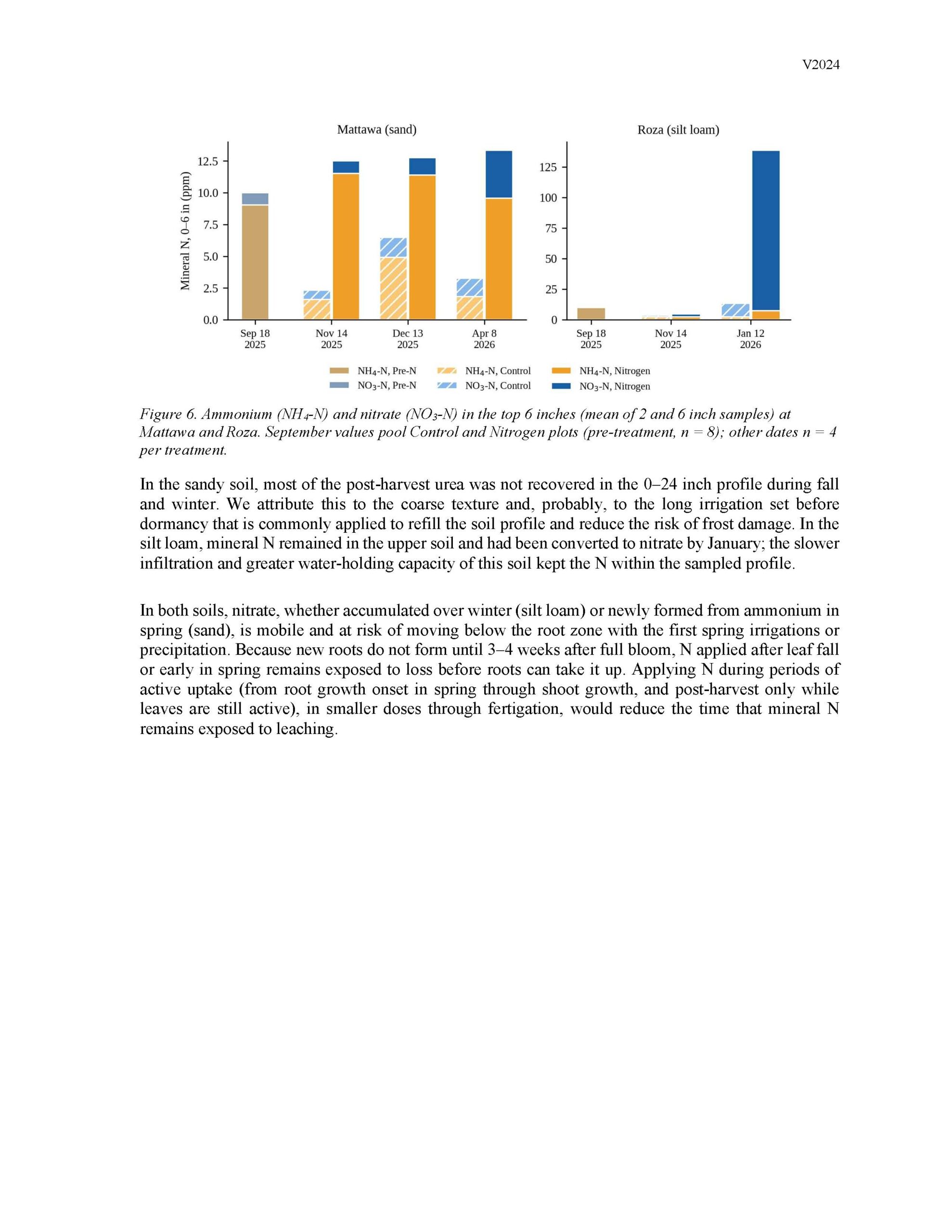
Summary: Nutrient recommendations for sweet cherry are usually based on fruit removal, while there is little information regarding demand prior to full production, during tree establishment. Over three seasons (2023–2025), we quantified biomass and nutrient partitioning by whole-tree excavation in a mature ‘Benton’ orchard (Gi5, Gi12 and MxM14; 6th–8th leaf) and a young ‘Black Pearl’ orchard at WSU IAREC (Gi6, Gi12 and Mazzard; 1st–3rd leaf), and in 2026 we compared the young orchard with two commercial blocks of the same age. We also evaluated methods to monitor root growth and evaluated the risk of leaching with post-harvest urea applications in a sandy and a silt loam soil. Fruit removed 3.1–4.0 lb N, 0.8–1.0 lb P and 4.0–5.8 lb K per ton, with small differences among rootstocks and among cultivars (when compared with our previous project). In sweet cherry, analyzing fruit flesh alone is enough to estimate removal. Whole-tree N in ‘Benton’ did not increase from the 6th to the 8th leaf, and new growth (1-year shoots, spurs and fine roots) held only 9% of tree N, most of which is recycled within the orchard. Annual N demand of mature orchards is therefore driven by yield: about 31–40 lb N/acre for a 10 tons/acre crop. In young orchards, nutrient demand is driven by biomass growth. Third-leaf ‘Black Pearl’ at WSU IAREC accumulated 64–88 lb N/acre (1,089 trees/acre), about twice the N applied over three years (34 lb N/acre). Commercial trees of the same age were 2–3 times larger, yet N stored per acre was similar in all blocks (49–88 lb N/acre) despite cumulative inputs of 34 to 300 lb N/acre. N concentration in tree biomass was consistent (about 4 g N per kg of fresh weight), so the N demand of new orchards can be estimated from expected growth and planting density rather than fixed annual rates. Root windows were the most practical monitoring tool; minirhizotron images were difficult to quantify, and ERT was confounded by soil moisture and temperature. In our study, new roots formed 3–4 weeks after full bloom, once the soil at 8 inches exceeded 49 °F, with the most growth from early June to the end of July. Scheduling N applications based on root growth should be considered for improving nitrogen use efficiency. Post-harvest urea applied in September was largely not recovered in the sandy soil profile, while in the silt loam it was converted to nitrate during dormancy (72–138 ppm above the control in the top 6 inches by January), when trees cannot take it up.